I've watched with amusement this whole switch to digital TV.
Of course, the government got involved and screwed it all up.
The Congress had set February 17, 2009, as the date when TV stations would stop broadcasting analog signals. Prior to all this, some stations were simultaneously broadcasting ("simulcasting") analog and digital signals.
The old TVs we all grew up watching are analog. Newer TVs might still receive analog signals, but they all receive digital signals, too. That's because Congress said that stations would have to stop broadcasting analog next month. The idea is that if those frequencies aren't used by TV stations, they can be used for other purposes.
Each analog TV channel takes up a wide bandwidth. Channel 2, for instance, is 55.25 MHz, but covers 54-60 MHz range. That is, the channel has the range of 54-60 MHz reserved, and properly tuned, it's 55.25 MHz. The spacing on each side is to prevent other sources (including adjacent channels) from interfering.
Your FM radio works the same way. If you notice, you will see that all FM stations have odd numbers in the decimal point. Say your favorite station is at 95.5 MHz. If you travel around, you'll eventually find a station at 95.3 and at 95.7 MHz. You won't find one at 95.4 or 95.6 MHz. That's so that there's a padding of .1 MHz on each side of each radio station to cut down interference.
AM radio has a similar process, but it's a larger padding. For instance, you might find a station at 1110 KHz, and another at 1120 KHz or 1100 KHz. But none at 1111-1119 KHz. The pad keeps stations from interfering.
TV channels do the same thing, but have a larger padding that's necessary because of the nature of the signals and the equipment.
Digital TV wouldn't need as much spacing. That means you can get more channels in less overall bandwidth, because they can sit closer to each other, or require less padding on each side.
That would free up a wide range of frequencies for other uses.
You see, lots of different technologies use frequencies between other technologies.
For example, on analog TV, channel 6 is 82-88 MHz. Channel 7 is 174-180 MHz. What takes up all that space in between 88 and 174 MHz? Lots of things. Including your favorite FM radio station.
So, digital TV makes sense from the efficiency standpoint.
But, there's more.
There's HDTV.
Some might think digital TV and HDTV are the same thing. They're not. HDTV is digital, but not all digital is HDTV.
Anyway, digital TV (including HDTV) is an improvement on things. In my opinion. But why should you have to do anything because I said so?
You don't.
But Congress says you should.
And they said that analog TV would stop broadcasting next month.
That means that if you get your signal over the air, you won't be able to receive signals after the cutoff. Unless you can also receive digital signals.
Keep in mind that if you get all your TV channels from cable or satellite, you're okay. More on this in a minute.
Older TVs won't handle digital signals. So, someone came up with digital converter boxes. You can buy them at Walmart. When they have them in stock.
Now, they cost about $50 each. And everyone who has an older TV and receives over-the-air broadcasts would have to pony up some cash to keep watching TV.
So, the government decided to help out. They offered discount cards for $40 off a digital converter box. So many people ordered cards that they ran out of funding for the discount cards.
Now, Congress is working to delay the cutoff. The Senate voted to move it to June. The House may follow suit.
What does all this mean?
The Congress messed things up. In other words, business as usual.
The whole process is screwed up.
First, digital TV is better. However, what good does it do to someone like my 95-year old grandmother who wants to watch Matlock? Not much. (Now, I should say that my grandmother has cable, and isn't impacted by the switch to digital. But someone else's grandmother might be impacted by the switch.)
Despite the fact that digital is better, the market will bear out things as the people want.
If enough people want digital TV, then the market will push digital TV.
True, the market sometimes makes bad decisions. Like VHS over Betamax. Betamax was better quality, but VHS took the market and Betamax died.
IBM PC technology took over the personal computer market. I personally think Mac is better, but PC rules the market. However, Mac and Linux are still around, although others have fallen by the wayside.
The bottom line is that the market will let people choose change at the rate they want change. If they want change.
People don't always make the best decisions regarding change. Just look at the recent presidential election.
But if you want a really bad decision, just turn it over to Congress.
Showing posts with label HDTV. Show all posts
Showing posts with label HDTV. Show all posts
Wednesday, January 28, 2009

Friday, May 30, 2008
Out with the old, in with the new ... TV
Got the new TV last night. Not a huge TV, by any means. But a larger, clearer picture, to be sure.
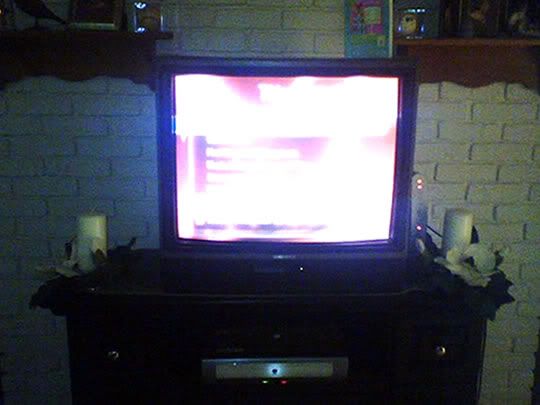
Here's the old one:

Here's the new one:

Yes, poorly lit room. Both pictures were taken with my cell phone. The first picture was taken with sunlight coming in from the right. The second picture was taken with lamplight coming from the left. But the size and clarity of the TVs are evident, from the distance, perspective, and same TiVo screen on each set.
Then, I sat down and put a Star Trek movie in. Is nice!
Now, to convince myself that I need to upgrade to digital cable. And HD.
Here's the old one:
Here's the new one:
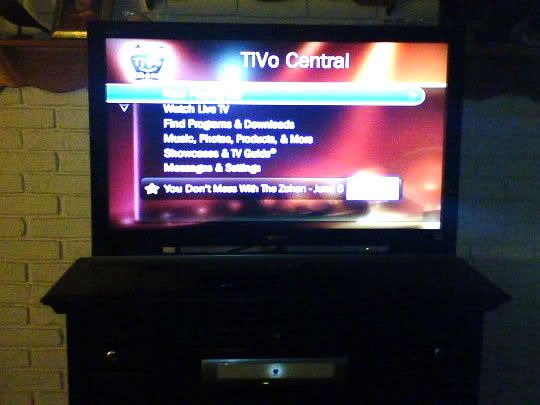
Yes, poorly lit room. Both pictures were taken with my cell phone. The first picture was taken with sunlight coming in from the right. The second picture was taken with lamplight coming from the left. But the size and clarity of the TVs are evident, from the distance, perspective, and same TiVo screen on each set.
Then, I sat down and put a Star Trek movie in. Is nice!
Now, to convince myself that I need to upgrade to digital cable. And HD.
Tuesday, May 27, 2008
HDTV
We're getting a new TV.
The old TV is ... well ... old.
Oh, it still works. But it's old. And it's a 26'' TV.
So, we're getting a new one.
We've actually been looking for some time, trying to decide just what we want.
 We settled on a Sony KDL-40V4100. That's a 40'' ... no, not a really big TV, but a good big larger than what we have today.
And, no, it's not the best TV out there. But Sony makes good stuff. And, we found a pretty good deal on it. So, that's what we've settled on.
And, we're picking it up Thursday. It'll interfere with my going to the baseball game; such is the price of technocracy.
Now that we're getting a new HDTV, we need to decide if we want to watch HD TV.
You see, we have basic cable. Runs about $43 a month. We get, oh, I count 68 channels. But it also includes a lot of channels I don't watch: QVC, Outdoor, Versus, Golf Channel, Lifetime, GAC, CMT, Food Network, E!, HGTV, MTV, BET, VH1, HSN, and others.
And they're all standard definition TV channels.
So, I went to the cable company's Website and checked on what's involved with their HD TV channels. They didn't have a whole lot of information. No pricing, no details, no much of anything.
So, I went by the cable company and asked questions. They acted like they had never been asked any questions.
But, to her credit, the young lady I spoke with did try to find out the answers to my questions.
So, what I found out is that in order to get their HD channels, I got to have their digital package. Which would up the monthly rate from $43 a month to $66 a month.
Then, TiVo complicates things.
We've had TiVo for a couple of years now. And we like it. So, I'm thinking we want a DVR.
Now, we have an older TiVo Series 2. Only records 1 show at a time. And doesn't work with HD channels.
So, we'd need to get a new TiVo if we want to watch HD channels.
What's all that mean?
If we want to watch HD TV broadcasts, we'd need to get a new TiVo. That's $300 for a Series 2 HD TiVo.
Then, $66 a month for and HD package from the cable company. Oh, wait. We'd need a cable card for the new TiVo. That makes it $70 a month. Plus the $12.95 a month for TiVo.
Or, we could get the cable company's HD package with their DVR. That would be $71 a month, with no monthly TiVo fee.
Or, we could just keep watching standard cable for $43 a month. Only, we'd be watching it on a better TV.
What are we going to do?
I have no idea.
The old TV is ... well ... old.
Oh, it still works. But it's old. And it's a 26'' TV.
So, we're getting a new one.
We've actually been looking for some time, trying to decide just what we want.
We settled on a Sony KDL-40V4100. That's a 40'' ... no, not a really big TV, but a good big larger than what we have today.And, no, it's not the best TV out there. But Sony makes good stuff. And, we found a pretty good deal on it. So, that's what we've settled on.
And, we're picking it up Thursday. It'll interfere with my going to the baseball game; such is the price of technocracy.
Now that we're getting a new HDTV, we need to decide if we want to watch HD TV.
You see, we have basic cable. Runs about $43 a month. We get, oh, I count 68 channels. But it also includes a lot of channels I don't watch: QVC, Outdoor, Versus, Golf Channel, Lifetime, GAC, CMT, Food Network, E!, HGTV, MTV, BET, VH1, HSN, and others.
And they're all standard definition TV channels.
So, I went to the cable company's Website and checked on what's involved with their HD TV channels. They didn't have a whole lot of information. No pricing, no details, no much of anything.
So, I went by the cable company and asked questions. They acted like they had never been asked any questions.
But, to her credit, the young lady I spoke with did try to find out the answers to my questions.
So, what I found out is that in order to get their HD channels, I got to have their digital package. Which would up the monthly rate from $43 a month to $66 a month.
Then, TiVo complicates things.
We've had TiVo for a couple of years now. And we like it. So, I'm thinking we want a DVR.
Now, we have an older TiVo Series 2. Only records 1 show at a time. And doesn't work with HD channels.
So, we'd need to get a new TiVo if we want to watch HD channels.
What's all that mean?
If we want to watch HD TV broadcasts, we'd need to get a new TiVo. That's $300 for a Series 2 HD TiVo.
Then, $66 a month for and HD package from the cable company. Oh, wait. We'd need a cable card for the new TiVo. That makes it $70 a month. Plus the $12.95 a month for TiVo.
Or, we could get the cable company's HD package with their DVR. That would be $71 a month, with no monthly TiVo fee.
Or, we could just keep watching standard cable for $43 a month. Only, we'd be watching it on a better TV.
What are we going to do?
I have no idea.
Subscribe to:
Posts (Atom)